Friday, July 23, 2010

June milk production up sharply

aking the nation as a whole, milk production was up 2.4 in June compared to a year earlier. In the top 23 states, milk output was up 2.7 percent. Milk production has been on the rise since February, but the size of June's jump was unexpected.
The growth is coming in higher milk production per cow. The average cow in the U.S. produced 3.7 percent more milk in June than a year ago. There were 108,000 (1.2 percent) fewer cows in the nation this June. But there were 40,000 more cows on U.S. dairy farms in June than there were in December. The U.S. dairy herd now has 9.122 million cows, the most since August 2009.

Industry observers are looking at several factors that could be contributing to the strength in per-cow milk production. The summer of 2009 was mild in the Upper Midwest, home to a lot of cows, and there could be some carryover effect. Also, many people cut back on vitamins, minerals, and other feed additives last year when they were losing money. They found out that the cows did not milk as well; nor were they as healthy or as easy to get bred so they put some of those ingredients back in the ration. Also, many problem cows were culled rather than doctored during the toughest times, and cull cow prices have been better recently. Those who started using sexed semen two or three years ago have more first-calf heifers freshening now so they can sell off more older cows. As a result, the U.S. dairy herd generally is more healthy and younger.

June milk production was up 3.5 percent in California. There was a 6.6 percent rise in milk per cow. Milk per cow jumped 4.7 percent in Wisconsin. With 5,000 more cows (+0.4 percent), Wisconsin milk output was up 5.1 percent in June. New York was up 0.2 percent. Idaho cow numbers were up 10,000 (1.8 percent), and milk production was up 3.5 percent. Michigan was a big gainer being up 4.7 percent with a big jump in milk per cow. Missouri experienced an 8 percent (9,000 head) drop in cow numbers and was down 5.4 percent in milk production.

Despite the milk production report last Monday, cheese prices on the Chicago Merc edged upward. On Tuesday, blocks added 2-1/4 cents a pound to move up to $1.60. Then blocks added another 1/4 cent yesterday.

Meanwhile, the average July through December Class III futures price went from $14.66 on Monday, before the announcement, to $14.63 on Tuesday to $14.64 yesterday. These are lower futures prices than any of us would like to see, but they did not react much to the June milk production report.

Labels: , ,


Wednesday, May 19, 2010

Milk production keeps climbing

April milk production in the top 23 dairy states was up 1.7 percent over last year, according to the USDA NASS Milk Production report released yesterday. This rise in milk production surprised many industry observers. The combination of higher cull cow prices and low milk prices was expected to result in a larger drop in cow numbers and, perhaps, a drop in milk output.

This was the second month this year that milk production was above year-earlier levels. March milk output in the top 23 states was up 0.9 percent.

In the top states, there were 155,000 fewer cows on farms in April than a year ago. However, there were 3,000 more cows in those states than in March.

Nationally, there were 186,000 fewer cows (-2 percent) on farms when compared to a year ago. However, there has been a 14,000-cow gain in the U.S. dairy herd since last December . . . 9.096 million head versus 9.082 million.

Milk per cow is the big story. Across the nation, April milk output per cow was up 3.5 percent from last year and averaged more than 60 pounds per day for the first time in history.
After being down for a number of months, milk production in California was up very slightly in April. Wisconsin milk production shot up 6.2 percent, mostly on a big, 5.8 percent jump in the amount of milk produced per cow. There were 5,000 more cows (+0.4 percent) on Wisconsin dairy farms.

Milk production in New York (+1.7 percent), Idaho (+3.3), and Pennsylvania (+2.8) was up. Both Texas (-2.2) and New Mexico (-1.7) were down.

Labels: , ,


Thursday, April 22, 2010

Milk production was up again

There was a 0.9 percent rise in milk production during March in the top 23 dairy states, according to USDA's Milk Production report released earlier this week. That was the second month in a row that milk production was above year-earlier levels despite the cost-price squeeze that's affecting dairy operations across the nation. USDA revised upward its estimate of the February rise to 0.3 percent from the original report of plus 0.1 percent.

The March jump of 0.9 percent in the top states came from a 1.9 percent drop in cow numbers and a 2.8 percent rise in milk per cow. There were 162,000 fewer cows in the 23 states than there were last March. Nationally, there were an estimated 193,000 fewer cows on dairy farms this March with the national dairy herd estimated at 9.09 million head.

California was down 0.7 percent in milk during March. Milk per cow was up 2.6 percent, but there were 63,000 fewer cows in the Golden State than a year ago, a 3.5 percent drop.
Wisconsin had the big jump with milk being up 6.3 percent in March. Nearly all of that gain came from the 6 percent rise in milk produced per cow.

The Number 3 dairy state, New York, was up 0.2 percent in milk, while Number 4, Idaho, was up 3 percent.

Other notable changes included Arizona which was down 7 percent in milk with 10 percent (19,000) fewer cows. Colorado was down 8.3 percent in milk with 9.4 percent (12,000) fewer cows. Missouri was down 8.4 percent in milk with 6.5 percent (7,000) fewer cows. Washington shot up 6.3 percent in milk with 4.2 percent (10,000) more cows and 3.6 percent more milk per cow.


Labels:


Monday, March 22, 2010

More milk . . . despite everything

Maybe we shouldn't have been too surprised with the February Milk Production report released last Thursday. After all, milk production in January had been down just 0.5 percent compared to a year earlier. Plus, the 23 top dairy states actually had 4,000 MORE cows in January than in December. The recent report showed that milk output in February was 0.1 higher than a year ago, and that the top states had another 3,000 more cows. That was not much of a rise in milk. But considering all that our industry has been through, many would think that cow numbers and milk production still should be going down.

The big driver of more milk this winter has been higher milk per cow. This especially was evident among states in the Upper Midwest which had one of the coolest summers on record last year. For example, cows in Wisconsin produced 5.3 percent more milk in February than they did a year ago.

Among the top 23 states, cow numbers were down 168,000 head (nearly 2 percent) in February. However, milk per cow in those states was up just over 2 percent. Nationally, the estimated cow count was 9.088 million head, which was down 201,000 or 2.2 percent from February 2009.

California continued its drop in milk production being down 1.6 percent. There were 65,000 or 3.6 percent fewer cows there. With its big jump in milk per cow, Wisconsin was up 5.7 percent in total milk production. Wisconsin had 5,000 more cows than a year ago. Among other Upper Midwest states, Michigan was up 3.5 per cent in milk and Minnesota was up 1.4 percent.

Seven states were down at least 5 percent in total milk output during February. They were Arizona (-6.8 percent), Colorado (-8.3), Florida (-5.0), Kansas (-6.8), Missouri (-9.8), New Mexico (-5.0), and Texas (-5.4). Most of these states were down mostly due to significant declines in cow numbers.

Labels:


Monday, March 1, 2010

2009 milk production statistics reveal few changes

USDA recently released the 2009 averages for state-by-state milk production, cow numbers, and milk per cow. A detailed report, complete with charts and tables, can be found the in the March 10 issue on page 169. Here are a few findings from USDA's report:

Cow numbers dipped slightly compared to the previous year’s 9.315 million which represented the highest inventory since 1996. Despite the drop, average cow numbers were still high with the nation’s 9.201 million cows running above average totals for 2001 to 2007. It should be stressed these are yearly averages. Estimated cow numbers in December 2009 stood at 9.082 million. Among the top 10 dairy states, those that reduced cow numbers were: California, down, 2.6 percent; New York, down 1.1 percent; Pennsylvania, down 0.7 percent; and New Mexico, down 3.8 percent.

Growth in milk per cow slowed for the fifth consecutive year, dropping to 0.9 percent compared to between 1.0 to 3.2 percent gains in the previous four years. Over the past decade, Arizona, Colorado, and Washington all took turns holding the top spot for milk per cow. This year, New Mexico has the nation’s highest-producing cows, breaking the 24,000-pound barrier for the first time.

Meanwhile, there was only one change in the top 10 milk production states with Michigan overtaking New Mexico. Milk production in the top production state, California, was down 4.1 percent, while production in the nation's second leading state, Wisconsin, was up 3.1 percent.

U.S. dairy farmers produced 618 pounds of milk for every American citizen. On a per capita basis, Idaho led all states producing 7,860 pounds of milk for every state citizen. The next three on the list were: Wisconsin, 4,463 pounds per resident; Vermont, 3,971 pounds per resident; and New Mexico, 3,933 per resident. A full-color map including all 50 states can be found in the March 10 issue.
MilkProd-02-19-2010-1.pdf

Labels: , ,


Tuesday, February 16, 2010

Holstein has a new milk production record-holder

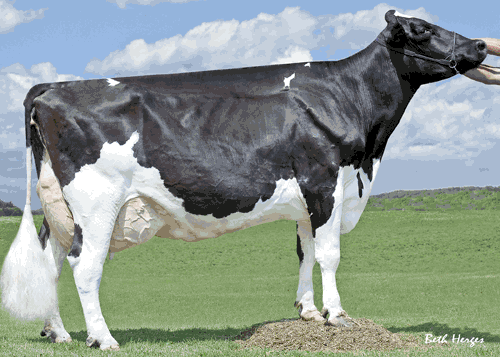
Ever-Green-View My 1326 -ET now holds the record for most milk produced in one single lactation by a Holstein. She is bred and owned by Thomas J. Kestell of Waldo, Wis. After a 365-day lactation, 1326-ET produced 72,170 pounds of milk, with 2,787 pounds of fat and 2,142 pounds of protein. That' a lot. A whole lot. What does that equate to? We did the math.
8,295 gallons of milk
or
If the average person drank three 8 oz. glasses of milk each day, she would have been able to sustain about 121 people each day for one year!
or
about 7,217 pounds of cheese — that's enough for 115,472 cheeseburgers (each with one ounce of cheese)

"She's always been a really good milk cow, and a very solid type cow," owner Tom Kestell says. "This record wasn't hard on her – she looks great and feels great. She just wasn't stressed out at all, just like the rest of her family." Ever-Green-View My 1326- ET, and was 4 years, 5 months when she made her record-breaking lactation. She is a Stouder Morty-ET daughter and is classified Excellent at 92 points. The farm — Ever-Green-View is owned Tom and Gin Kestell, with son Chris involved in the operation. They have 130 cows with a BAA of 109.7 percent and a Rolling Herd Average of 35,151 pounds of milk, 1,351 pounds of fat, and 1,083 pounds of protein. Congratulations on this incredible accomplishment!

Labels: ,


Tuesday, January 19, 2010

December milk down 0.8 percent

December milk was down 0.8 percent compared to a year earlier for the top 23 dairy states, reports NASS in its January 19, 2010, Milk Production report. When looking at the entire country, milk production was down 1.o percent for the last quarter (October to December) and down 0.9 percent for December.

For the top 23 dairy states, total milk cows were down 206,000 head compared to last December. However, when compared to just a month earlier, milk cows are steady. Cows still in herds are more productive, up 29 pounds compared to a year earlier, for a 1,758-pound monthly average per cow.

On a national basis, preliminary numbers suggest milk production was down 0.4 percent for the past year. Total milk stood at 189,259 million pounds for 2009. The estimated 9.2 million cows in the national herd averaged 20,572 pounds per cow this past year. A finalized report will be released next month.

Western states again led the states that were down in production this past December. The largest drops in production included:
• Colorado, down 11.1 percent
• Arizona, down 10.9 percent
• Missouri, down 8.0 percent
• Kansas, down 5.1 percent
• California, down 4.6 percent
• New Mexico, down 3.2 percent
• Utah, down 2.7 percent

The Midwestern states again led the gainers:
• Wisconsin, up 4.3 percent
• Iowa, up 3.6 percent
• Minnesota, up 3.2 percent
• Washington, up 1.9 percent
• Indiana, up 1.8 percent
• Ohio, up 1.2 percent
• Michigan, up 2.4 percent


MilkProd-01-19-2010.pdf

Labels: , ,


Wednesday, October 21, 2009

September milk production down 0.7 percent

Announced on Tuesday, September milk production was down 0.7 percent. That’s more than the 0.1 percent (revised) decline in August. In the 23 major dairy states, production totaled 13.9 billion pounds, down from 14 billion in September 2008. Cow numbers declined by 32,000 from last month, and now total 8.34 million milk cows. That’s 168,000 fewer than a year ago. In response, milk futures shot higher yesterday, along with butter and cheese.

The three states with the largest decline in milk compared to 2008 all were western states, including Arizona at a loss of 10.8 percent; Colorado, 7.1 percent; and California, 6.4 percent.

Midwest states and Texas had the largest gains in September. Top three gainers included Indiana that increased production by 5.8 percent; followed by Wisconsin, 5.2 percent; and Texas, 4.9 percent when compared to 2008.

Labels: , ,


Monday, September 21, 2009

August milk report a repeat of July

Continued cool weather throughout the Midwest led to a near photocopy of the July milk production data for this August as states in that region again ranked near the top for milk production gains. This time, Illinois led all states, up 5.4 percent. It was followed by neighboring Indiania, up 4.9 percent. Meanwhile, fellow Midwestern states including Michigan, Minnesota, and Wisconsin were up 4.6 to 3.7 percent.

Even with the Midwest's growth in milk production, overall output for August was down 0.2 percent compared to a year ago when looking at the top 23 dairy states. Like last month, Arizona again posted the largest drop, down 7.4 percent. It was followed by California, down 4.5 percent. Other Western states including Idaho, Colorado, Utah, New Mexico, and Washington were down 3.1 to 1.1 percent.

Compared to a year ago, milk production per cow was up 25 pounds. Meanwhile, there are 143,000 fewer cows compared to last year for the top 23 dairy states. When all states are included, there are 174,000 fewer cows compared to last December.

Labels:


Tuesday, September 1, 2009

Cool July made for milk-making weather in the Midwest


Cow comfort was running high as cool weather ushered in some of the best summertime milk-making weather. When reviewing the July milk production numbers in our Friday, August 28, blog, you will note that Midwest milk production was up 3.9 to 5.9 percent in six states which rank among the top 20 nationally for milk production. It just so happens that all six of those states had regions within their state that experienced record lows for the combination of daily highs and lows, making heat stress a nonissue throughout the area.

Only two states in the continental U.S. posted temperatures cooler than Minnesota and Wisconsin. So it came as no surprise that those two states lead the nation for July milk, up 5.9 and 5.8 percent, respectively. The National Oceanic and Atmospheric Administration reports Wisconsin posted the second coolest July on record, while Minnesota had its third coolest July.

Meanwhile, Iowa, Illinois, and Indiana were up 3.9 to 4.8 percent on July milk, and each of these three states experienced the coolest July on record. And neighboring Michigan, with the coolest July on the U.S. mainland was up 4.6 percent. Michigan's combination average of 63.5 for the daily high and low was second coolest on record.

While these cool temperatures have been great for cows, the corn and soybean crop is behind schedule. Cool temperatures simply mean crops are behind on maturity due to the fact there are not enough Growing Degree Days (heat units) compared to the average summer. An early frost could have a huge impact on the corn and soybean harvest.

Labels: ,


Friday, August 28, 2009

Milk production up in Midwest, down in West

This may be the first time we’ve written this headline in 30 years or more, which speaks volumes about just how topsy-turvy things have become in the dairy industry these days.

After decades of relentless production decline in the Midwest and unstoppable growth in the West, the regions’ much different business models have obviously been impacted much differently by the unprecedented collapse in milk prices since late last year. The recent July 2009 Milk Production report from USDA-NASS shows just how differently.

Of the nine Western states in the agency’s monthly survey of 23 leading states, seven posted production declines compared to July 2008. The combined reduction of all nine states was 249 million pounds. Fewer cow numbers almost across the board, plus frequently lower production per cow, are why.

Of the eight Midwestern states in the survey, seven posted production increases and the combined increase by all eight states was 227 million pounds. In those states cow numbers were typically higher and production per cow was often much higher.

Percent changes in milk production, Western States vs. Midwest states, July 2009 vs. July 2008:

West
Arizona -8.2%
California -5.0%
Colorado -1.6%
Idaho -3.5%
New Mexico -2.8%
Oregon +1.6%
Texas +1.4%
Utah -1.9%
Washington -1.6%

Midwest
Illinois +3.9%
Indiana +4.0%
Iowa +4.8%
Michigan +4.6%
Minnesota +5.9%
Missouri -0.8%
Ohio +1.4%
Wisconsin +5.8%

Labels: , , ,


Tuesday, August 18, 2009

July milk up 0.1 percent

Despite negative returns on nearly every U.S. dairy, farmers are still not reducing milk output. In the just-released milk production data from USDA's National Agriculture Statistics Service, July milk was reported to be up 0.1 percent. Likewise, June's revised production totals were the same amount compared to a year ago.

Among the top 23 dairy states, five were down over 2 percent, and all but one was in the West. Arizona was down 8.3 percent; California, down 5 percent; Vermont, down 4.5 percent; Idaho, down 3.5 percent; and New Mexico, down 2.8 percent.

Meanwhile, Minnesota leads all gainers, up 5.9 percent while its neighbor, Wisconsin, was up 5.8 percent. Virginia matched Wisconsin's gain. Lastly, Iowa, Michigan, Indiana, and Illinois were up 4.8 to 3.9 percent.

Labels:


Friday, July 10, 2009

More milk produced farther from consumers

People are getting more interested in where their food is produced, as well as how it is being produced. Consider the proliferation of farmers’ markets in cities large and small across the country. Some food industry observers see this trend continuing with people wanting to know more about where their food comes from.

We thought of this when we saw the May 2009 issue of Marketing Service Bulletin from the Central Milk Marketing Order office. The article, “Cows versus people” compared milk marketings (federal order plus California) and population figures (dairy production consumption) for the four U.S. time zones. The analysis assumes that dairy product consumption is the same in all time zones and that it amounts to 50 pounds of milk per month . . . 25 pounds for fluid and Class II products and 25 pounds for cheese, butter, and so forth.

For December 2008, the Eastern time zone had 47.8 percent of the population but produced only 30 percent of the milk. That resulted in a deficit of 21.7 pounds per person or 3.1 billions of milk for the month.

The Central time zone was closer to balance with 30.9 percent of the milk and 29 percent of the population. Still, that time zone was deficit 172.9 million pounds of milk for the month.

Taken together, the Eastern and Central time zones were deficit about 3.3 billion pounds of milk for the month.

By contrast, the Pacific time zone has 29 percent of the milk marketings but only 16.5 percent of the population. It had a 1.4 billion-pound surplus for the month. The Mountain time zone had 10.2 percent of the marketings and 6.6 percent of the people.

This underscores the amount of milk (dairy product) that moves from west to east in this country. Many people on both the milk-producing and milk-processing sides of the business are concerned about where milk is being produced and the cost of moving dairy products to market. This a worthy concern as we look at higher transportation costs in the years ahead and the changing way that consumers view their food supply.

Labels: ,


Monday, July 6, 2009

Improved results with 3x milking


June 15 was an exciting day for Hoard's Dairyman. After months of discussion
and planning, the farm finally made the switch to 3x milking. Even though
the obvious reason for the change was to increase overall milk production,
there were other motives for moving to 3x milking.

"We wanted to show that Guernsey cows not only can perform, but also be
profitable in the modern dairy industry," said Jason Yurs, the farm manager.

Moving away from the previous 2x milking at 3 a.m. and 3 p.m., the milking
times at Hoard's Dairyman Farm are now at 4 a.m., 12 p.m., and 7:30 p.m. The
farm has already seen promising results. Of the 300 cows milking at Hoard's
Dairyman Farm, milk production increased an average 3 pounds/cow within a week
of the switch. Milk production continued to climb until the Wisconsin summer
weather moved in where there were a few days with a heat index above 100
degrees Fahrenheit.

There is a lot more planning when deciding to switch to 3x milking than one
might realize. The change has caused the farm to rearrange its entire daily
schedule. More employees are being trained to fill in the extra milking
times. Also the previous milkers and other farm employees have reorganized
their routine and working hours to fit around the new milking times. Calves
are now being fed earlier, and herd health check has moved to Monday afternoon
instead of Monday evening.

The farm will look for increased milk production throughout the summer.

Labels: ,


Thursday, June 18, 2009

Milk production staying strong

Despite the long stretch of low milk prices and feed costs that are climbing again, milk production and cow numbers have not changed as much over the past six months as many would have expected. An old, hard-hearted saying is that “low milk prices are the cure for low milk prices.” This means that, when things get tough on dairy farms, more people quit milking or, at least, cull more heavily or feed less, reducing milk per cow. That has not been happening during the current downturn . . . so far.

May milk production actually was up 0.2 percent over a year ago in the top 23 milk states. Milk production in both April and March were up 0.1 over a year ago.
Milk per cow was up 0.5 percent during May in the top 23 states which was enough to offset a 0.3 percent (25,000 head) drop in cows compared to last May. There were 10,000 fewer cows in those states in May than there were in April.

Nationally, there were 11,000 fewer cows in May than April and 43,000 fewer cows than last May. Most of the CWT cows in the current herd retirement round will go out in June.
Of the top five dairy states, all were down in milk production except Wisconsin which was up 1.9 percent from last year. California was down 1.9 percent; New York, -0.8; Idaho, -1.4; and Pennsylvania, -0.8.

Big gainers were Kansas (+6.8 percent milk) with 4.3 percent (5,000) more cows and Texas (+6.3) with 18,000 or 4.4 percent more cows. Arizona was down 6.2 percent in milk, mostly because of a 5 percent drop in milk per cow compared to last year.

Labels: , ,


Monday, May 18, 2009

April milk production stable

Despite today's low milk prices, milk production figures held steady for April. National milk production was down just 0.1 percent, while figures for the top 23 dairy states (which produce 92.5 percent of the nation's milk) were up 0.1 percent. Cow numbers were down slightly with 3,000 fewer cows compared to April 2008 and 2,000 fewer head than March 2009, according to the USDA report released May 18.

Among the top dairy states, milk production in:
• California was down 2.3 percent
• Wisconsin was up 1.6 percent
• New York was down 0.5 percent
• Idaho was down 1.5 percent
• Pennsylvania was down 1.9 percent
• Minnesota was up 2.9 percent

Other states of note included:
Texas up 7.2 percent
Florida up 5.9 percent
Kansas up 5.o percent
Washington down 3.4 percent
Vermont down 5.0 percent

Labels:


Wednesday, February 25, 2009

Cow numbers highest in over a decade

Cow numbers are way up. Since 2004, there are 305,000 additional cows on U.S. dairy farms putting total cow numbers at 9.315 million. The growth has been gradual, ranging from 2005’s 0.3 percent and topping out with this year’s 1.4 percent. To put the current cow population in perspective, the last time we had over 9.315 million cows was 1996.

Overall, total milk production was up to 190 billion pounds which is a 2.3 percent increase from the previous year. That 2.3 percent increase is right in the middle of the 2.1, 2.8, and 3.5 percent gains in national milk production during the prior three years.

Growth in milk per cow slowed for the fourth consecutive year, dropping to 1.4 percent compared to 1.6 to 3.2 percent in the previous three years. The order of the top 10 states changed slightly: Texas (+14 percent rose from eighth to seventh; New Mexico (+7.9 percent) rose one spot to eighth, while Michigan (+1.8 percent) fell from seventh to ninth.

For a full report on 2008 milk production, check out our March 10 issue.

Labels: , ,